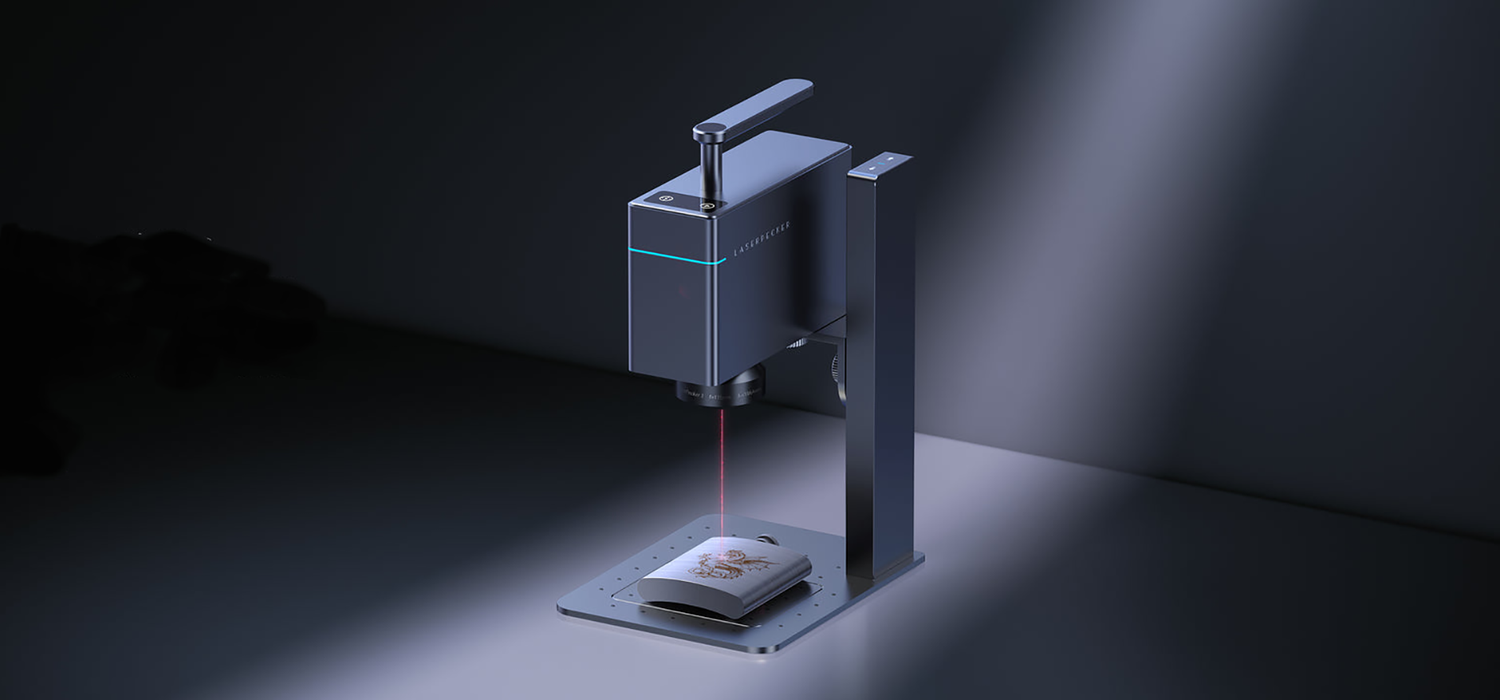
Most consumer laser engravers utilize 450nm blue diode modules. While blue light excels at cutting organic fibers like basswood, cardboard, and leather, its physical wavelength reflects heavily off bare polished metals. Anyone who has attempted to mark a stainless steel pet tag or gold ring with a standard diode laser knows the frustrating result: faint surface discoloration or scorched chemical marking sprays.
The LaserPecker 3 fundamentally shifts physics by deploying a pulsed 1064nm infrared laser source paired with high-speed galvano-mirror deflection. At λ = 1064 nm, bare metals absorb photonic energy directly rather than bouncing it away. Compressing the laser spot down to an microscopic 0.01 × 0.01 mm (10 µm), this handheld compact unit promises true industrial-grade resolution on titanium, sterling silver, brass, aluminum, and dense polymers.
We spent three weeks testing the LaserPecker 3 in our workshop lab across 15 different metal alloys and synthetic blanks. Here are the unvarnished engineering findings.
Technical Specifications and Optical Principles
The core difference between the LaserPecker 3 and gantry-style desktop engravers lies in its solid-state architecture:
| Specification Parameter | LaserPecker 3 Lab Data | Typical 10W/20W Diode Engraver |
|---|---|---|
| Laser Wavelength | λ = 1064 ± 10 nm (Pulsed Infrared) | λ = 450 to 455 nm (Continuous Blue) |
| Optical Spot Diameter | 0.01 × 0.01 mm (10 µm) | 0.08 × 0.10 mm (80 to 100 µm) |
| Beam Deflection System | Dual-Axis High-Speed Galvo Mirrors | Belt-driven Cartesian X/Y Gantry |
| Maximum Engraving Speed | 600 mm/s (36,000 mm/min) | 100 to 400 mm/s |
| Engraving Resolution | Up to 4K (user-adjustable dpi) | 254 to 500 dpi |
| Effective Working Area | 115 × 115 mm (Standard) | 400 × 400 mm |
| Focal Length / Standoff | 115.0 ± 0.5 mm | 20.0 to 50.0 mm |
| Total Head Weight | 1.15 kg (2.53 lbs) | 3.5 to 7.0 kg |
Physics Principle: Wavelength selectivity dictates laser-material interaction. Photons at 1064 nm interact directly with the free conduction electrons in transition metals, creating rapid thermal ablation with zero need for messy molybdenum-based marking sprays or anodized coatings.
Workshop Benchmark Testing on Bare Metals
We evaluated the LaserPecker 3 across common jeweler and maker materials using standard vector text, line grids, and photographic bitmaps:
1. 304 Stainless Steel Watch Backs and Cutlery
Stainless steel represents the bread and butter of personalized gifts:
- Engraving Precision: At 4K resolution and 80% power, the machine resolved 0.5 mm tall sans-serif typography with razor-sharp edge contrast. Under an optical microscope, individual stroke boundaries showed zero thermal blowout.
- Color Temperature Effects: By modulating laser frequency and travel speed (40 to 120 mm/s), the infrared beam produced deep matte black marks or reflective gold-bronze oxidation without penetrating deep enough to compromise water-resistance seals.
2. Bare Polished Brass and Copper
Copper and high-zinc brass are notoriously difficult because of their extreme thermal conductivity:
- Result: While high-heat 455nm blue diodes fail completely, the 1064nm pulsed beam carved clean, permanent serial numbers into bare brass stock at 150 mm/s with two passes.
3. Anodized Aluminum and Titanium
- Anodized Coatings: Vaporizes dyed oxide layers instantly at 500 mm/s, leaving crisp white graphics.
- Pure Titanium: Achieved consistent deep gray annealing with excellent scratch resistance against abrasive steel wool tests.
4. Dense Plastics (ABS, Acrylic, Nylon)
Infrared interaction on synthetic resins behaves differently than CO2 lasers:
- Black ABS & Matte Nylon: Excellent, high-contrast white foaming effect that is impossible to replicate with a diode laser.
- Clear Acrylic: Fails. 1064nm radiation passes straight through transparent acrylic sheets just like blue light does.
Focusing and Software Workflow
Focusing an infrared beam requires specialized assistance because 1064nm light is completely invisible to the human eye. Operating an invisible beam without alignment cues would be hazardous and inaccurate.
LaserPecker handles this with dual visible red targeting beams:
- Red-Dot Convergence: Two secondary red diode dots project from the laser housing. Lowering or raising the motorized electric stand until the two dots merge into a single sharp point calibrates exact focal standoff at 115 mm.
- High-Speed Galvo Framing: Unlike gantry machines that crawl around a rectangle to preview positioning, the galvo mirrors project the exact vector contour in real time at 30 frames per second, allowing instantaneous workpiece alignment.
Important Material Limitations: What It Cannot Do
Being clear about what this machine cannot accomplish is essential before spending over a thousand dollars:
- Zero Wood Cutting or Wood Engraving: The 1064nm pulsed infrared wavelength passes through raw wood, plywood, and paper fibers with virtually zero energy absorption. It will not cut, engrave, or even warm up a piece of pine. For woodwork, review our guide to the best laser engraver for wood.
- Compact 115 × 115 mm Envelope: This is a precision jeweler and personalization tool, not a signage production cutter. Engraving large cutting boards or industrial panels is physically impossible without repositioning jigs.
- Surface Ablation, Not Deep CNC Milling: While it produces permanent, indelible marks that resist solvent wipe-down, it is not a 50W industrial fiber laser capable of deep metal gunsmithing engravings in seconds.
Comparative Assessment: LaserPecker 3 vs. Alternatives
Here is how the LaserPecker 3 stacks up against comparable benchtop marking options:
| Tool Model | Laser Technology | Primary Material Focus | Portability | Average Price |
|---|---|---|---|---|
| LaserPecker 3 | 1064nm Pulsed Infrared | Metals, Jewelry, Rigid Plastics | Handheld / Mobile | ~$1,199.00 |
| LaserPecker LP2 | 450nm Blue Diode | Wood, Leather, Paper, Coated Metal | Handheld / Mobile | ~$799.00 |
| xTool F1 Ultra | 1064nm MOPA + 455nm Diode | Dual-Source (Wood + Metal) | Benchtop Portable | ~$2,898.00 |
| Monport 20W Fiber | 1064nm Fiber Galvo | Deep Industrial Metal Engraving | Stationary Bench (60 lbs) | ~$1,899.00 |
Final Lab Verdict
The LaserPecker 3 is a specialized, surgical instrument designed specifically for craftsmen, jewelers, knife makers, and custom retail shops who need to mark bare metal, stainless tumblers, watches, and plastics with zero fuss and microscopic detail.
If you already own a wood laser or 3D printer and need dedicated, portable metal marking capability that fits in a padded travel case, the LaserPecker 3 is unmatched in convenience.
You can inspect current package bundles and verify current availability on Amazon:
- View the LaserPecker 3 on Amazon to check real-time stock and bundle options.